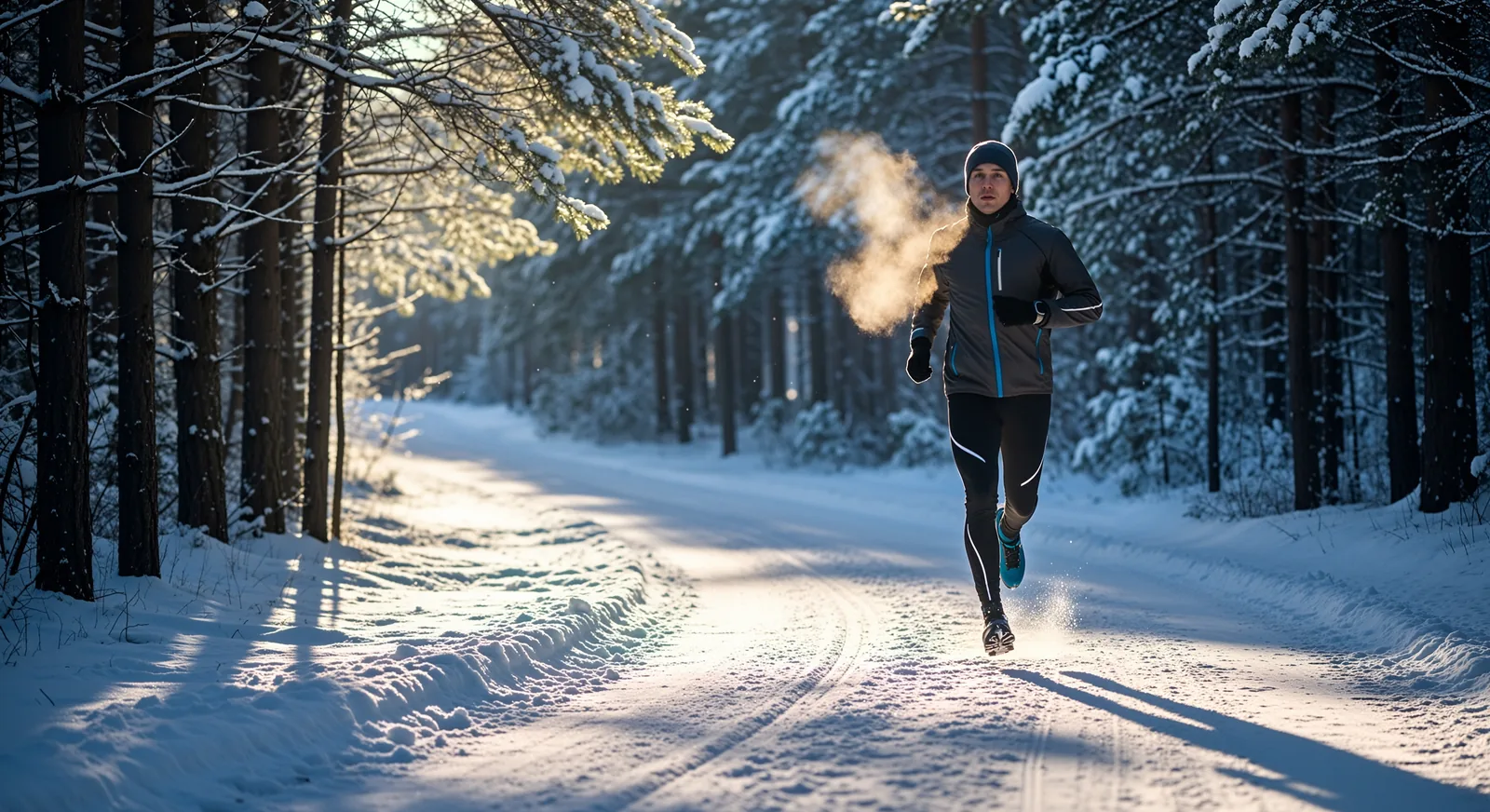
Every year, on the first truly cold morning, someone tells me to be careful breathing that air. The idea is that cold air will freeze or burn your lungs.
It will not. By the time air reaches the deep parts of your chest, your body has already done most of the work of warming it. The cold does change your running. Just not in the way most runners think.
That matters right now. Here in Boulder, the first real cold tends to show up around this time of year. If you are racing New York on November 1 or CIM on December 6, race morning may be colder than any run in your build. And if Boston is next, most of that build will happen in winter.
The myth: cold air damages your lungs
The burning feeling in your chest on a cold run is real. But it is your airways working hard, not tissue freezing.
Your nose, mouth, throat, and upper airways act like a heat exchanger. Every breath passes over warm, wet surfaces that add heat and moisture before the air goes deeper.
We know this from direct measurement. In 1982, E. R. McFadden and colleagues published temperature recordings taken from inside the airways of healthy people breathing subfreezing air, in the Journal of Clinical Investigation. Most of the warming happened in the upper airways. When the air got colder and breathing got faster and deeper, the cooling reached farther down the airway tree, but the body kept warming the air along the way.
That last detail is the important one for runners. Hard running means big, fast breaths. The colder the air and the harder you breathe, the deeper your airways have to work. That is where the real issue starts.
The real problem is dry air
Warming air is easy for your body. Humidifying it costs water. Cold air holds very little moisture, so your airways give up water from their own lining with every breath.
As that lining dries out, it gets saltier. In some people, that change triggers the smooth muscle around the airways to tighten. This is exercise-induced bronchoconstriction. It is why some runners cough for an hour after a cold workout, or feel a tight chest that has nothing to do with fitness.
It is more common in cold-weather endurance athletes than most people assume. Randall Wilber and colleagues tested members of the 1998 US Winter Olympic team, published in 2000 in Medicine & Science in Sports & Exercise. About 23 percent tested positive. Among cross-country skiers, the athletes who breathe the most cold air for the longest, it was 50 percent.
Those are elite skiers racing hard in subfreezing air, not a typical runner on an easy loop. But the mechanism is the same. If hard cold-weather sessions leave you wheezing or coughing, get it checked by a doctor instead of writing it off as being out of shape. It can be diagnosed, and it is usually very manageable.
A simple step on very cold days is a light buff or neck gaiter over your mouth. Your exhale leaves some warmth and moisture in the fabric, and part of it comes back on the next breath. It is a low-tech way to do some of your airways' job for them.
Cool is fast
Here is the good part. For racing, cool weather is where marathon times are best.
In 2007, Matthew Ely, Samuel Cheuvront, William Roberts, and Scott Montain published a study in Medicine & Science in Sports & Exercise comparing years of marathon results with the weather on race day. They used WBGT, a heat-stress index that accounts for humidity and sun as well as air temperature.
The coolest group of races, a WBGT of about 5 to 10°C (roughly 41 to 50°F), produced the fastest times. Performance slowed step by step as conditions warmed. And slower runners lost more time to warmth than the leaders did.
One honest caveat. That study did not look at races much colder than its coolest group. Below freezing, other problems show up: footing, wind, stiff legs, and runners wearing too much. Cool is fast. Frigid is a different question.
What cold does to your legs
The cost of cold mostly lives in your muscles, especially early in a run.
Muscle works better warm. The chemical reactions that power contraction run faster, nerve signals travel faster, and the muscle produces force more quickly. Cold muscle is stiffer and less powerful.
In a 1987 study in the European Journal of Applied Physiology, Anthony Sargeant warmed and cooled the leg muscles of his subjects before short, all-out cycling efforts. Compared with normal resting muscle, cooling the muscle to about 18°C cut peak force and power by about 12 percent. Warming it raised them by about 11 percent. It was a small lab study of sprint efforts, not distance running.
Your legs will never get that cold on a run. But the direction is the point. It explains why the first mile on a cold morning feels clunky, and why a workout started cold feels harder than the paces say it should.
What I do about it:
- Warm up longer before anything fast. On a cold day I add 5 to 10 minutes of easy running before a workout, then a few strides.
- Go straight from the warm-up into the work. Do not stand around and let your legs cool back down.
- Jog the recoveries. Standing rest between reps in the cold undoes your warm-up.
- Cover your legs when it is really cold. Tights are not just for comfort. They help keep the working muscle warm.
You still sweat. You just do not feel thirsty.
Most runners drink less in winter. Part of that is habit. Part of it is your body turning down the thirst signal.
Robert Kenefick and colleagues at the University of New Hampshire tested this, published in 2004 in Medicine & Science in Sports & Exercise. Men exercised in cold (4°C, about 39°F) and warm conditions, both fully hydrated and already dehydrated. In the cold, thirst was reduced by up to about 40 percent.
The mechanism is clever, and a little sneaky. Cold makes the blood vessels in your skin tighten to save heat. That pushes more blood toward your core. Sensors there read the extra volume as plenty of fluid, so your brain releases less of the water-saving hormone vasopressin and you feel less thirsty, even when you are low on water.
Meanwhile you are still sweating under your layers, and losing water with every dry breath. So on long runs, keep the same drinking and fueling plan you used in the fall. Do not wait to feel thirsty. In the cold, that signal shows up late.
How I dress, and when I move it inside
This part is practical experience more than research.
- Dress for a run 15 to 20 degrees warmer than the thermometer. It is a common rule of thumb, not a study, but it holds up. If you feel comfortable standing outside before the run, you will be too hot by mile two.
- Hands and ears first. Gloves and a hat do more per ounce than a heavier jacket.
- Start into the wind. Finish with it at your back, so you are not running into it once you are sweaty.
- Respect the wind chill. The National Weather Service says exposed skin can freeze in 30 minutes at a wind chill of about -19°F. Long before that point, the treadmill is the better call.
- Ice is not worth it. No workout is worth a fall. Move the fast running to a treadmill or swap the day.
On race morning in the cold, wear throwaway layers to the start, gloves you do not mind tossing, and keep your warm-up short and close to the corral so you do not cool off waiting.
Where NXT RUN comes in
Winter does not care what your plan says. Some mornings, the workout on the calendar meets 12 degrees, a 20 mph wind, and a sheet of ice on your usual loop.
That is what Workout Difficulty Adjustment is for. One tap makes today's session easier, so a cold, windy morning gets a workout that fits the conditions instead of a hard effort you grind through on bad footing. Your plan keeps moving forward, and you stay consistent through the months that decide how your spring goes.
This article is general education, not medical advice. If you have asthma, chest tightness, or breathing trouble during or after exercise, talk with a doctor. Frostbite and hypothermia are real risks in extreme cold, so follow local weather guidance.